
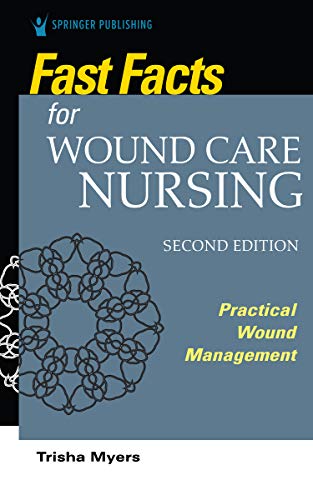
Fast facts for wound care nursing : practical wound management / Trisha Myers.
Material type: TextLanguage: English Series: Fast facts (Springer Publishing Company)Publisher: New York, NY : Springer Publishing Company, LLC, [2022]Edition: Second editionDescription: pages cmContent type:
 - text
- unmediated
- volume
- 9780826195029
- WO 39
| Item type | Current library | Shelving location | Call number | Status | Date due | Barcode | Item holds | |
|---|---|---|---|---|---|---|---|---|
 General Book
|
Kuakarun Nursing Library | Shelving Cart | WO 39 M885 2022 (Browse shelf(Opens below)) | Available | 0000047285 |
Browsing Kuakarun Nursing Library shelves Close shelf browser (Hides shelf browser)

|

|

|

|

|

|
|
||
| WO 375 ว774 2551 ตำราวิสัญญีวิทยาคลินิก | WO 375 ส257ท 2547 เทคนิคทางวิสัญญีวิทยา เล่มที่ 4 : การป้องกันอาการปวดหลังผ่าตัด | WO 39 I213p 1992 Pocket companion for medical surgical nursing | WO 39 M885 2022 Fast facts for wound care nursing : practical wound management / | WO 39 R844e 2016 The essential burn unit handbook | WO 440 ก499 2557 การระงับความรู้สึกเด็ก | WO 440 ก499 2557 การระงับความรู้สึกเด็ก |
Preceded by Fast facts for wound care nursing / Zelia Ann Kifer. c2012.
Includes bibliographical references and index.
Attacking the Basics: What Fuels a Wound --- The Phases of Wound Healing and Types of Wound Closure --- Acute Wounds --- Chronic Lower Extremity Wounds --- Pressure Injuries --- Atypical, Complex Wounds --- Assessing Wounds --- Documenting and Photographing Wounds --- Selecting the Correct Dressings --- Biologic Agents and Skin Substitutes -- Wound Debridement -- Hyperbaric Oxygen Therapy --- Caring for Ostomies and Fistulas --- The Promotion of Skin Integrity --- Selecting Optimal Support Surfaces and Patient Positioning --- Qualifications and Certifications for Wound Care --- Facility Accreditation --- The Center for Medicare and Medicaid Healthcare's Common Procedural Coding System
""Wounds" - What a broad term! The Original Roget's International Thesaurus gives all of the following terms for "wounds": trauma, injury, hurt, lesion, cut, incision, scratch, gash, puncture, stab, laceration, mutilation, abrasion, gangrene, necrosis, and more. If Roget were a healthcare provider looking at a wound for the first time, he would not stop with just a simple surface term. In a split second, he would send all that information to his mental search engine for processing. His simple surface term, abrasion, would generate more sensory input such as: classifications - common, complex, or atypical, chronic, or acute, and bioburden - clean, dirty, infected, and so on. Before heaving a big sigh, he might have contemplated nutrition and pain management. After all this was sufficiently processed, another broad concept would surface. "I need a remedy." Roget's brain interface system would go into overdrive, bouncing from one neuron to neuron as more definitions came to mind, such as : relief, help, restorative, medicine, drug, soothing, debridement, salve, antibiotics, poultices, bandage, healing, curative, restorative, palliative, protective...oh, and coming up for air...preventive. Whew!"-- Provided by publisher.
There are no comments on this title.